- Jan 4, 2025
William Hogarth: An Iconic British Satirist
- Quil Castro
- 0 comments

William Hogarth has been celebrated as both the Father of English Painting and the father of modern satirical art; thanks to his significant contributions to art and culture. Born on November 10, 1697, in Smithfield, London, and passing away on October 25, 1764, in Chiswick, Hogarth's life was rich with artistic exploration. Not just a painter, he was also an engraver, printmaker, and satirical cartoonist. His unique style, now known as Hogarthian, left a lasting legacy.
William Hogarth was born into a family that suffered from financial instability. His father, Richard Hogarth, was a schoolmaster and writer, but struggled and was at one point imprisoned for the inability to pay his debt. William's early awareness of societal inequalities contributed to his artistic perspective. As a young apprentice, Hogarth gained impressive technical skills, which led him to mastering the intricate art of engraving metal plates to produce prints. Later, he mastered oil painting, which is what he is most recognized for today.
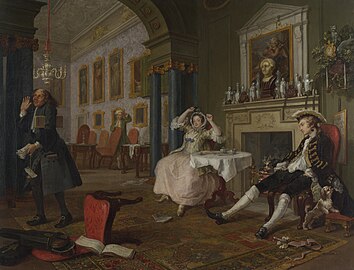
In the 1730s, Hogarth gained fame with his “modern moral subjects,” which are paintings/engravings critiquing the manners and morals of contemporary society. Series including A Harlot’s Progress and A Rake’s Progress resonated deeply with the people. His work reflected their lives and societal issues in a way that was both powerful and relatable by exposing hypocrisies and injustices; unlike the traditional portraiture and religious art of his time.
One example is his series Marriage A-la-Mode (1743-1745). It used satire to criticize superficial arranged marriages, greed and vanity among the aristocrats. By combining fine art and pop culture, Hogarth made his works accessible to a broad audience. This accessibility was further enhanced by selling engravings of his paintings, allowing his art to reach beyond elite galleries into the hands of everyday citizens.
Hogarth was not just an artist but also an advocate for artists' rights and the role of art in society. In 1735, he helped pass the Engravers' Copyright Act, later known as the "Hogarth Act," that provided legal protection against unauthorized reproductions of artists' work. The beginning of our copyright laws today! He also contributed to charitable causes, including the Foundling Hospital, demonstrating how art could drive social change. Hogarth's meticulously detailed works and his ability to capture the human condition with humor and empathy continue to inspire artists and writers today.
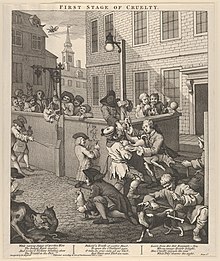
His work can be seen at St Bartholomew's Hospital in London, where two of his giant paintings are displayed. Despite his explicit instructions against varnishing, they were layered with varnish over time, but have since been restored for limited public viewing. His paintings are also preserved in the National Gallery and the Foundling Museum in London. Amazingly, Hogarth’s family home in Chiswick still stands and has been converted into a museum showcasing prints of his work and recovered family belongings.
Famous Quotes:
“I have generally found that persons who had studied painting least were the best judges of it.”
“I have endeavored to treat my subjects as a dramatic writer; my picture is my stage, and men and women my players, who by means of certain actions and gestures, are to exhibit a dumb show.”
“I know of no such thing as genius, genius is nothing but labor and diligence.”
Learn more about this artist here:
https://www.nationalgallery.org.uk/artists/william-hogarth
https://www.britannica.com/biography/William-Hogarth
https://coramstory.org.uk/explore/content/article/william-hogarth/